The rule: FAA Part 107
Small commercial drones in the US fly under 14 CFR Part 107, the Small Unmanned Aircraft Systems rule. It covers aircraft under 55 pounds. The headline limits:
| Item | Part 107 requirement |
|---|---|
| Pilot | Remote pilot certificate under Part 107, held by the person flying (or directly supervising) |
| Aircraft | Under 55 lb including payload; registered with the FAA; Remote ID compliant |
| Altitude | Up to 400 ft above ground level, or higher within 400 ft of a structure |
| Sight | Kept within visual line of sight of the pilot or a visual observer |
| Speed | No faster than 100 mph (87 knots) |
| Night | Allowed after the updated training, with anti-collision lighting visible for 3 statute miles |
| Airspace | Authorization needed in controlled airspace (Class B, C, D and surface-area E) |
Flying over people and over moving vehicles is allowed only within the categories and conditions the rule sets, and the category depends on the drone. Anything outside the limits, such as flying beyond visual line of sight, needs an FAA waiver. The FAA has proposed a new rule for routine beyond-visual-line-of-sight operations; check its status, because until it takes effect, waivers are the path.
The remote pilot certificate
The person flying needs an FAA remote pilot certificate. To get one you must be at least 16, pass the initial aeronautical knowledge test at an FAA-approved testing center, and complete the application in the FAA's IACRA system, including TSA security vetting. After that, you keep the certificate current by completing the free online recurrent training every 24 calendar months.
If an employee flies for you, they hold the certificate, not the company. Keep a copy on file and track their recurrent training date. Carry the certificate when flying; the FAA or police can ask to see it.
Registration and Remote ID
Registration. Every drone flown under Part 107 must be registered with the FAA through FAADroneZone, whatever its weight. The small-drone exemption under 250 grams applies only to recreational flying. The registration number must be marked on the outside of the aircraft.
Remote ID works like a digital license plate: the drone broadcasts its identity and location, and the location of the control station, while it flies. There are three ways to comply:
- A standard Remote ID drone, with broadcast built in. Most current commercial drones are.
- A Remote ID broadcast module attached to an older drone. With a module, the drone must stay within visual line of sight of the pilot.
- An FAA-Recognized Identification Area (FRIA), where drones without Remote ID may fly. These are mostly club fields and schools, and rarely useful for business work.
Check that the drone's serial number or the module's serial number is entered on its FAADroneZone registration; a registered drone with no Remote ID serial on file is not compliant.
Airspace: LAANC and DroneZone
Much of the area around airports is controlled airspace, and many business sites sit inside it. Before flying there under Part 107 you need FAA authorization. There are two routes:
- LAANC (Low Altitude Authorization and Notification Capability) gives near-real-time approval through FAA-approved apps, up to the altitude shown on the FAA's UAS facility maps for that grid square. It covers many airports but not all.
- FAADroneZone takes manual requests for places or altitudes LAANC cannot approve. These take longer, so apply well ahead of the job.
Also check for temporary flight restrictions (stadiums, VIP movements, wildfires), and for local rules on where you may take off and land. Cities, parks and property owners can restrict launch sites even where the FAA controls the airspace.
Which drone for which job
- Photography and marketing: a camera drone with a large sensor, a stabilized gimbal and good wind handling.
- Roof and building inspection: zoom cameras, and a thermal camera for moisture and heat loss. Obstacle sensing matters close to structures.
- Survey and mapping: an RTK-capable drone and photogrammetry software for measured orthomosaics and volumes. Lidar payloads for vegetation and detailed terrain.
- Agriculture spraying: heavy aircraft, often over 55 lb loaded, that need a Part 137 agricultural aircraft operator certificate and exemptions in addition to Part 107. This is specialist work.
Costs people miss
Spare batteries (most work needs three or more), a charging hub, the mapping or inspection software subscription, insurance, pilot time for training and recurrent training, and replacement after crashes. The FAA does not require liability insurance for Part 107, but clients, property managers and general contractors usually do, and a standard business policy may exclude aircraft.
If you do government work, federal and some state rules restrict drones from certain foreign manufacturers. Check the contract before you buy the aircraft.
Remote ID broadcast modules
Affiliate linksA broadcast module lets an older drone meet the FAA Remote ID rule. A drone flown with a module must stay within the pilot's visual line of sight.

Ruko
Ruko R111S Remote ID Module for Drone with GPS Tracker/Finder and Beeper

Holy Stone
Holy Stone FAA Compliant Remote Identification broadcast Module Spare Parts for GPS Drones with Camera for Adults 4K, Remote ID broadcast Module Parts comply with US FAA Regulation; No worry about FAA

Spektrum
Spektrum Sky Remote ID Module, SPMA9500
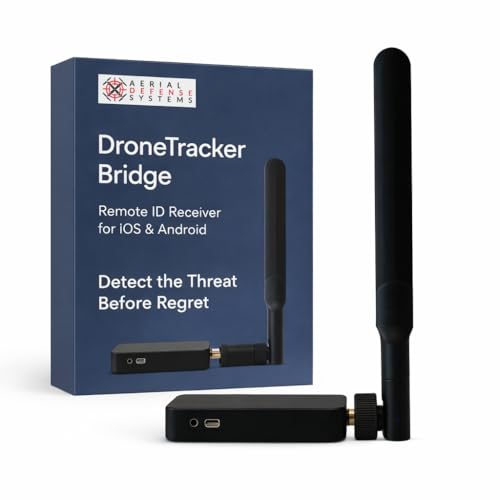
Generic
Drone Detector & Remote ID Receiver - Portable Wireless Airspace Awareness Device for Compatible Phones and Tablets
Prices retrieved from Amazon on 2026-09-29 and may since have changed; the price on Amazon at the time of purchase is the one that applies. As an Amazon Associate we earn from qualifying purchases, at no extra cost to you. No manufacturer pays for a place in this list.
Before you buy
- Get the pilot a Part 107 remote pilot certificate and diarize recurrent training every 24 months.
- Choose a standard Remote ID drone, or budget for a broadcast module.
- Register the aircraft for Part 107 and mark the number on it.
- Check whether your usual sites sit in controlled airspace and whether LAANC covers them.
- Buy liability insurance that covers aircraft, and hull cover if the drone is expensive.
- Budget batteries, software and training, not only the aircraft.
- For survey work, confirm RTK and the software your clients expect.
- Check contract restrictions on drone origin before government or utility work.
Other robots in this series: robotic mowers and security robots, or browse the robots hub.