The detection letters
- UV (ultraviolet). Genuine US currency paper does not glow under UV light, and the security thread in a $5 and up glows a color specific to its denomination. UV catches notes printed on ordinary bleached paper and many "washed" notes.
- MG (magnetic). Parts of US notes are printed with magnetic ink. A sensor checks for it. Catches most inkjet and laser copies.
- IR (infrared). Checks features that appear, or disappear, under infrared light. Catches better counterfeits that pass UV and MG.
- MT (metal thread) checks for the security thread. DD (double detection) stops two notes stuck together being counted as one. Size detection catches foreign or odd-sized notes.
No counter is a guarantee. A machine that flags a note is a prompt to check it by hand: the watermark, the security thread, the color-shifting ink on the lower right numeral of a $10 and up.
Piece counters and value counters
A piece counter counts notes. You sort the drawer by denomination first and count each stack. A value counter (mixed-denomination counter) reads each note's value with an image sensor and totals a mixed stack, so a drawer can be counted without sorting it. Value counters cost several times as much and pay for themselves where several drawers are counted every day.
What else to check
- Batch mode stops at a set count, for strapping in 100s.
- Hopper capacity and speed matter less than detection for most shops.
- Currency support, if you take euros or Canadian dollars.
- Updates. Currency designs change. A counter whose detection can be updated lasts longer.
Bill counters with counterfeit detection
Affiliate linksLook for UV, MG and IR together. UV alone catches bleached notes; magnetic and infrared catch most of the rest.

PONNOR
PONNOR Money Counter Machine with Value Count, UV/MG/IR/MT/DD Counterfeit Bill Detection, Dollar Euro Cash Counter with Count/Add/Batch/Auto Modes, External LCD Display

Aneken
Aneken Money Counter Machine with Value Count, Dollar, Euro UV/MG/IR/DD/DBL/HLF/CHN Counterfeit Bill Detectors,Add and Batch Modes, Cash Counter with LCD Display

BillMaster
Money Counter Machine with Value Count & Counterfeit Detection UV MG IR DD | Counts USD, EUR, CAD & MXN | 1300 Bills/Min | Commercial Cash Counter for Small Business | US Support

LOLARAN
LOLARAN AL1000 Money Counter Machine with Value Counting for USD & EUR, UV/MG/IR/DD/DBL/HLF/CHN Counterfeit Detection, LCD Display, Count/ADD/Batch/AUTO/Manual Modes, 1,300 Notes/Min
Prices retrieved from Amazon on 2026-09-29 and may since have changed; the price on Amazon at the time of purchase is the one that applies. As an Amazon Associate we earn from qualifying purchases, at no extra cost to you. No manufacturer pays for a place in this list.
Mixed-denomination value counters
Affiliate linksReads the denomination and totals a mixed stack, so a drawer can be counted without sorting it first.

VEVOR
VEVOR Mixed Denomination Money Counter Machine, 1200 Notes/Minute, Cash Counter with Value Count, UV/MG/IR/DD/DBL/HLF/CHN Counterfeit Detection, TFT Display, Money Counting Machine for Dollar and Euro
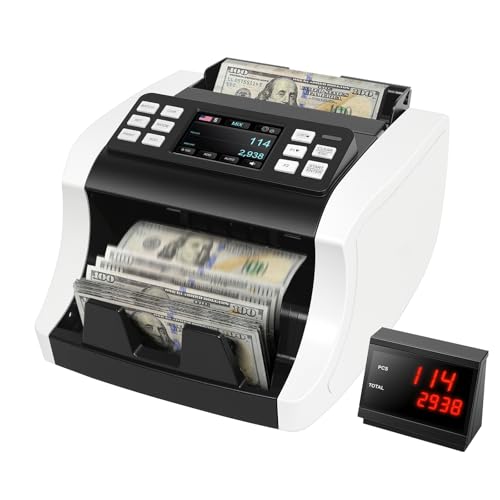
NUCOUN
NUCOUN VC-1 Money Counter Machine Mixed Denomination Bill Value

Aneken
Aneken N60 Mixed Denomination Money Counter Machine, Value Counting, UV/MG/IR/DD Counterfeit Detection, 3.5" TFT Display Cash Counting Machine, Printer Enabled Bill Counter for Business

MUNBYN
MUNBYN IMC22 Money Counter Machine Mixed Denomination, Dual-Display, CIS/UV/IR/MG Counterfeit Detection Bill Counter, USD, MXN, EUR, CAD Cash Counter for Business, Merchant, 2Y Protect (Black)
Prices retrieved from Amazon on 2026-09-29 and may since have changed; the price on Amazon at the time of purchase is the one that applies. As an Amazon Associate we earn from qualifying purchases, at no extra cost to you. No manufacturer pays for a place in this list.