VA and watts
Every UPS has two ratings. VA (volt-amperes) is apparent power; watts is the real power it can deliver. The ratio between them is the power factor. A consumer unit rated 1,500 VA may deliver only 900 W. Your equipment draws watts, so the watt rating is the one you size against, and every model page in the UPS register shows both.
Leave headroom
Size for about 20% more than your measured load. A UPS running near its limit has short runtime, runs its battery harder, and has nothing left for the moment a laser printer or a drive array draws a spike. And never plug a laser printer into the battery side of a small UPS: its fuser draws far more than it looks.
Runtime is not linear
Halve the load and you get well over double the runtime, because batteries deliver more of their capacity at lower current. Across the 847 certified units that report both figures, runtime at half load is a median of 3.0 times the runtime at full load. For most offices the point of a UPS is a clean shutdown or a few minutes of ride-through, not hours. For hours you need extended battery packs or a generator.
The three topologies
- Standby (offline). Passes mains power through and switches to battery when it fails. Cheap and efficient. Fine for a single desktop.
- Line-interactive. Adds automatic voltage regulation, correcting sags and surges without going to battery. The usual choice for small offices, network closets and point of sale.
- Online (double conversion). Rebuilds the power continuously, so the load never sees the mains. The cleanest output and zero transfer time, at the cost of lower efficiency. The norm for servers and data centers. Many modern units offer an eco mode that bypasses the conversion when mains is clean.
Sine wave output
Cheaper units produce a stepped approximation of a sine wave on battery. Some computer power supplies with active power factor correction can shut down on that waveform. If your equipment is recent, a pure sine wave unit is the safer choice.
Batteries wear out
Sealed lead-acid UPS batteries typically last three to five years, less in a hot room. Lithium-ion units cost more and last longer. Most units run a self-test; when it fails, replace the battery rather than the UPS.
Desktop UPS units
Affiliate links600 to 1,500 VA line-interactive units carry a computer, monitor and router through a short outage and a clean shutdown.

CyberPower
CyberPower CP1500PFCLCD PFC Sinewave UPS Battery Backup and Surge Protector

APC
APC BX1500M UPS Battery Backup & Surge Protector for Computers, Electronics

CyberPower
CyberPower CP1500AVRLCD3 Intelligent LCD UPS Battery Backup

Vertiv
Vertiv Liebert PowerUPS 200 PSA6E-1500LVT UPS Battery Backup 1500VA AVR
Prices retrieved from Amazon on 2026-09-29 and may since have changed; the price on Amazon at the time of purchase is the one that applies. As an Amazon Associate we earn from qualifying purchases, at no extra cost to you. No manufacturer pays for a place in this list.
Replacement UPS batteries
Affiliate linksSealed lead-acid UPS batteries usually last three to five years. Match the voltage, capacity and terminal type.

Mighty Max Battery
Mighty Max Battery ml9-12 - 12 Volt 9 ah, f2 Terminal, Rechargeable SLA agm Battery,Pack of 1
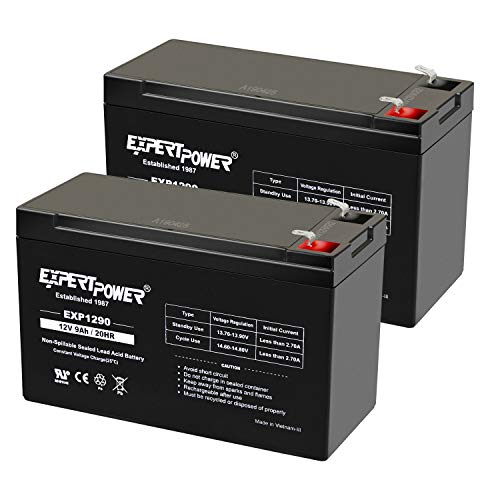
ExpertPower
ExpertPower EXP1290, 2 Pack 12V 9AH SLA AGM Rechargeable 12V Battery Backup

Mighty Max Battery
Mighty Max Battery ML9-12 - 12 Volt 9 AH SLA Battery - Pack of 2

ExpertPower
ExpertPower EXP1290, 12V 9AH SLA AGM Rechargeable 12V Battery Backup
Prices retrieved from Amazon on 2026-09-29 and may since have changed; the price on Amazon at the time of purchase is the one that applies. As an Amazon Associate we earn from qualifying purchases, at no extra cost to you. No manufacturer pays for a place in this list.