The types
| Type | How it cuts | Capacity | Best for |
|---|---|---|---|
| Rotary trimmer | A round blade runs along a rail | A few sheets at a time | Photos, signs, proofs; the safest for shared use |
| Lever guillotine | A long arm swings the blade down | A small stack | General office trimming; fast, needs care |
| Manual stack cutter | A lever or wheel drives a blade through a clamped stack | A ream or so of paper | Short runs of business cards, flyers and forms |
| Electric stack cutter | A motor drives the blade; two-hand operation | Deeper stacks, fast repeat cuts | In-house print rooms and schools |
Capacity figures on the box are quoted for light paper, typically 20 lb. Coated and card stock take fewer sheets, and cutting at the full rating wears the blade and leaves a less square cut.
Accuracy: clamps, guides and squareness
A stack of paper shifts as the blade enters it, and the bottom sheets end up a different size to the top. Three features prevent that:
- A clamp that holds the stack down before and during the cut. On a stack cutter it is essential; on a guillotine, a spring-loaded paper hold-down helps.
- A back gauge that sets the cut position and holds it for repeat cuts, ideally with a readout or a fine-adjust wheel.
- A square fence and a rigid base. Cheap cutters flex, and a slightly out-of-square cut shows on every card in a run.
Some stack cutters show a light line or laser guide where the blade will fall. It speeds up lining up printed crop marks.
Safety
A paper cutter can cause a serious hand injury in a moment. Choose the design to suit the least experienced person who will use it.
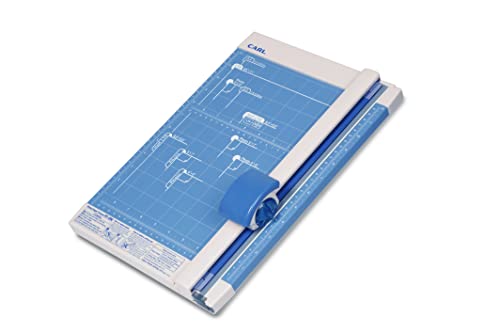
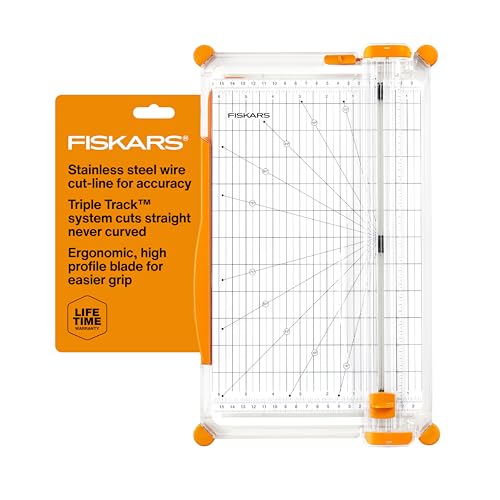
- Rotary trimmers keep the blade enclosed in its carriage. They are the right choice for shared offices and classrooms.
- Guillotines should have a finger guard along the cutting line and a blade latch that locks the arm down when not in use.
- Electric stack cutters should require two-hand operation, so both hands are on the controls when the blade moves, and have a clear guard at the front.
OSHA's machine guarding rules for general industry cover point-of-operation hazards like a blade, and employers must train the staff who use cutting equipment. Keep powered cutters in a room where only trained people use them.
Which cutter for which job
- Trimming the odd photo, sign or proof: a rotary trimmer with a cutting length a little longer than your largest sheet. Tabloid-length trimmers cover most office needs.
- Cutting a few sheets to size, often: a sturdy lever guillotine with a guard and a hold-down. Faster than a rotary for straight cuts on small stacks.
- Business cards, tickets, flyers printed several-up: a stack cutter with a clamp and back gauge, so every cut in the run lands in the same place. Some offices use a dedicated business card slitter for that one job instead.
- Daily print-room trimming: an electric stack cutter, installed where only trained staff use it, ideally with a service contract.
Printing several items per sheet with crop marks and a bleed makes cutting quicker and hides small errors. Ask whoever designs the job to set it up that way.
Costs people miss
- Blades dull with use. Rotary blades are cheap to swap; stack cutter blades are sharpened by a specialist or replaced, and you need a spare to keep working.
- Cutting sticks on stack cutters are the strip the blade lands on. Rotate or replace them when the bottom sheets stop cutting cleanly.
- Cutting mats on rotary trimmers wear in the same way.
- Floor space and weight. Electric stack cutters are heavy; check the floor and the doorway.
Before you buy
- Estimate the thickest stack you need to cut in one pass, in your actual paper.
- Count how many people will use it and how experienced they are.
- Pick a rotary trimmer for shared use, a stack cutter for runs of cards and flyers.
- Check for a clamp, a back gauge and a square fence.
- Confirm the safety features: blade lock, guard, two-hand controls on powered models.
- Price spare blades, sharpening and cutting sticks.
Pair it with a folding machine, binding machine or laminator for in-house finishing. For documents that need destroying rather than trimming, see shredder security levels.
Rotary trimmers
Affiliate linksThe enclosed blade makes these the safest choice for shared offices and classrooms.

Dahle
Dahle 507 Personal Rotary Trimmer, 12" Cut Length, 7 Sheet Capacity, Self-Sharpening, Automatic Clamp, German Engineered Paper Cutter
CARL
Carl Manufacturing 12200 Rotary Trimmer 12-Inch 10 Sht Cap. 10-1/4-Inch x12-Inch x3/4-Inch GY
Fiskars
Fiskars SureCut Deluxe Paper Cutter, Precise Trimmer Tool, 12" Cut Length

CARL
CARL Professional Rotary Paper Cutter with Clear Window - 12" Trimmer with Metal Base, Magnetic Guide, Calibrated Extension - Precise Paper, Label, Photo & Craft Cutting Tool
Prices retrieved from Amazon on 2026-09-29 and may since have changed; the price on Amazon at the time of purchase is the one that applies. As an Amazon Associate we earn from qualifying purchases, at no extra cost to you. No manufacturer pays for a place in this list.
Stack and guillotine cutters
Affiliate linksFor runs of cards and flyers. Look for a clamp, a back gauge and a blade lock.

HFS
HFS Heavy Duty Guillotine Paper Cutter, 400-Sheet Capacity, 12-Inch A4

VEVOR
VEVOR Heavy Duty Paper Cutter, 12" Industrial Commercial Guillotine Paper Cutter for A4 Paper, 400 Sheet Capacity, Solid Steel Construction, Stack Paper Trimmer for Office Home School Shop, White

Flisin
Guillotine Paper Cutter Heavy Duty 12 inch ,400 Sheet Capacity A4 White

HFS
HFS(R) Heavy Duty Guillotine Paper Cutter 400 Sheet Capacity | Solid Steel Construction (A3-17'' paper cutter)
Prices retrieved from Amazon on 2026-09-29 and may since have changed; the price on Amazon at the time of purchase is the one that applies. As an Amazon Associate we earn from qualifying purchases, at no extra cost to you. No manufacturer pays for a place in this list.