The styles compared
| Style | Punch pattern | Editable? | Best for |
|---|---|---|---|
| Comb (plastic) | Rectangular holes, 19 on a letter-size edge | Yes; open the comb, add or remove pages | Internal reports, manuals, training binders. Cheapest per book. |
| Twin-loop wire | 3:1 pitch (3 holes per inch) for thinner books, 2:1 for thicker | No, once closed | Proposals, presentations, calendars. Lies flat and turns 360 degrees. |
| Coil (spiral) | Usually 4:1 pitch, round holes | Awkward; the coil unwinds out | Workbooks and manuals that get handled hard. Flexible and hard to crush. |
| Thermal | No holes; glue in a heated cover spine | Some systems can reheat and reopen | Reports with a clean, book-like spine. Does not lie flat. |
| Strip (VeloBind style) | A row of small holes and a rigid strip | No | Legal and formal documents; very secure, does not lie flat. |
For a typical office producing internal documents, comb binding is the practical default: cheap supplies, easy edits, and wide availability. For documents that go to clients, wire looks sharper and lies flat on a table. Coil is the one to choose for anything that will be thrown in a bag or used on a job site.
Pitch, and why it locks you in
Pitch is the hole spacing, stated as holes per inch. A 3:1 wire needs 3:1 punched holes, and a 4:1 coil needs 4:1 holes. A machine punches one pattern unless it has interchangeable dies, so a wire machine cannot do coil. If you need two styles, look for a modular machine with swap-out dies, or buy two machines.
Wire comes in 3:1 for thinner books and 2:1 for thicker ones; the larger 2:1 holes allow bigger wire diameters. Check the machine's pitch against the supplies you can buy easily.
Two capacities, often confused
- Punch capacity is how many sheets it punches in one pass, typically quoted on 20 lb paper. Card covers and heavier paper cut the number. A book of 100 sheets on a machine that punches 15 at a time takes seven passes.
- Binding capacity is the thickest finished book the machine can close, set by the largest comb, wire or coil it accepts.
If you bind often, the punch capacity decides how long it takes. An electric punch takes more sheets per pass and saves wrists on long runs; worth it anywhere binding is a weekly job.
The specifications that matter
- Open throat lets you punch longer edges, such as a tabloid sheet or a landscape calendar.
- Adjustable margin depth moves the holes in from the edge for thick books, so pages do not tear out.
- Wire closer built in for wire machines; a coil inserter and crimping pliers for coil.
- Warm-up time for thermal binders, and a cooling rack so books set without the spine shifting.
Finishing touches that change the result
The binding is only part of how a document looks. A clear PVC or polypropylene front cover protects the title page and makes a printed report look finished; a card or leather-grain back gives it a stiff base. For client documents, printing a full-color cover on heavier stock and binding it in costs little more and looks far more deliberate than a plain cover sheet.
Print the pages with a wide enough inside margin, so text does not disappear into the holes. Most word processors have a gutter setting for this. For double-sided documents, set mirror margins so the gutter alternates sides. Proof one bound copy before running the full batch.
Costs people miss
- Supplies in every diameter you need, and in your color. A cheaper machine with costly supplies is not cheap.
- Covers: clear front sheets and card backs finish a document properly.
- Punch dies dull over time; heavy users need them sharpened or replaced.
- Thermal covers must match the spine width to the document thickness, so you stock several sizes.
Before you buy
- Decide the binding style from how the documents are used and who sees them.
- Check whether you need to add or remove pages later.
- Measure your thickest document and match the binding capacity.
- Count sheets per week to judge whether you need an electric punch.
- Confirm the pitch and that supplies are easy to buy in your sizes.
- Check for disengageable pins if you bind anything other than letter size.
If binding is a big part of your output, a production copier with an inline finisher can staple, hole-punch and fold as it prints. See also paper cutters and laminators.
Comb binding machines
Affiliate linksThe practical default for internal documents: cheap supplies and easy to add pages.

Amazon Basics
Amazon Basics Comb Binding Machine, 350 Sheets Capacity, Punches 12 Sheets, for Paper Sizes A5(15 holes)/Letter(19 holes)/A4(21 holes) with Adjustable Margin, Grey
HOUYEE
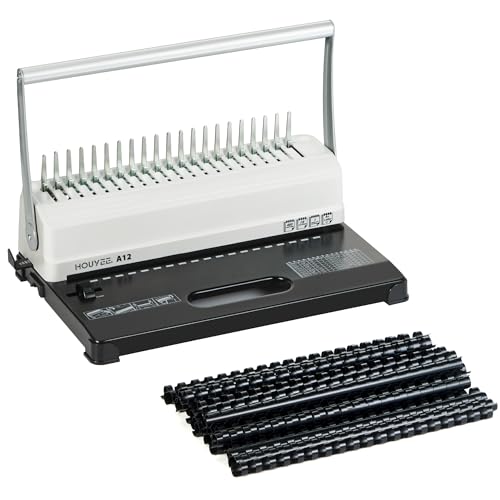
HOUYEE Comb Binding Machine,19 Holes, with 50 PCS 1/2" Binding Combs Spines

MAKEASY
MAKEASY Binding Machine, 21-Hole, Comb Binding Machines with 1 Box Comb Bindings Spines, Comb Binder for Letter/A4/A5 Paper, 12 Sheet Punch Capacity

MYFULLY
MYFULLY Comb Binding Machine, 21-Holes, 450 Sheets, Paper Punch Binder with Starter Kit 100 PCS PVC Comb Bindings Perfect for Letter Size, A4, A5 or Smaller Sizes Office Documents
Prices retrieved from Amazon on 2026-09-29 and may since have changed; the price on Amazon at the time of purchase is the one that applies. As an Amazon Associate we earn from qualifying purchases, at no extra cost to you. No manufacturer pays for a place in this list.
Wire binding machines
Affiliate linksTwin-loop wire gives client documents a sharp finish and lies flat. Check the pitch against supplies.

RAYSON
RAYSON TD-132 3:1 Wire Binding Machine, 12-Sheet Punch, 120-Sheet Capacity

RAYSON
RAYSON TD1202R 3:1 Wire Binding Machine, 12-Sheet Punch, 120-Sheet Capacity

CGOLDENWALL
CGOLDENWALL Round Holes Wire Binding Machine 3:1 Pitch 34 Holes

RAYSON
Rayson TD-1500B34 Wire Binding Machine, 3:1 Pitch, 15 Sheets Punch, 130 Sheets Bind
Prices retrieved from Amazon on 2026-09-29 and may since have changed; the price on Amazon at the time of purchase is the one that applies. As an Amazon Associate we earn from qualifying purchases, at no extra cost to you. No manufacturer pays for a place in this list.
Binding combs, wires and covers
Affiliate linksStock each diameter you use, plus clear front covers and card backs.
SIMPROFFICE
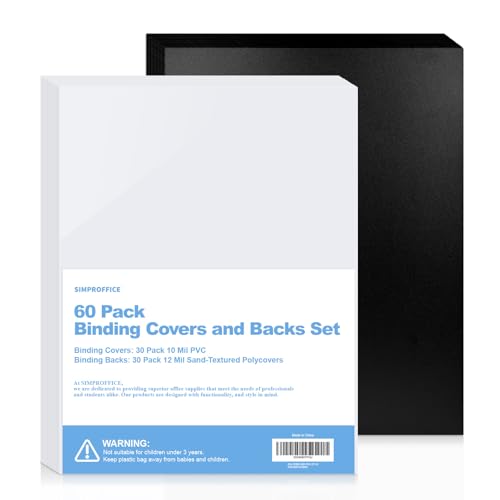
SIMPROFFICE 60 Pack Binding Covers and Backs, 10/12 Mil, 8.5X11"

StyEdEk
StyEdEk 24 Pack 8.5 x 11 Inches PVC Clear Binding Covers, 8 Mil

Binditek
Binditek 8 Mil PVC Binding Covers, 8.5 x 11 Inches, Clear, 100 Pack

Binditek
Binditek 200 Pack Binding Covers Set, 8.5x11 Inches, 8Mil PVC & 12Mil Poly
Prices retrieved from Amazon on 2026-09-29 and may since have changed; the price on Amazon at the time of purchase is the one that applies. As an Amazon Associate we earn from qualifying purchases, at no extra cost to you. No manufacturer pays for a place in this list.