Do you need one at all
If your files already live in Microsoft 365, Google Workspace or another cloud service, a NAS is optional. It earns its place when you have large files the cloud handles slowly (video, CAD, photo archives), software that needs a local file share, security camera recordings, or a need for a local copy of cloud data. For running applications and virtual machines, see the servers guide instead.
How many bays
- Two bays hold a mirrored pair. Simple, cheap, and enough for a small office file share.
- Four bays are the usual business choice: room for RAID 5 or RAID 6 and space to grow by swapping in larger drives.
- Six bays and up, or rackmount units, suit video work, heavy camera recording, or storage for several departments.
Buy more bays than you need today. Filling empty bays later is easy; moving to a bigger unit means copying everything across.
RAID levels in plain terms
RAID spreads data across several drives so the NAS keeps running when one fails. Each level trades usable space against how many drives can fail at once.
| Level | Drives | Survives losing | Usable space | Suits |
|---|---|---|---|---|
| RAID 1 | 2 | 1 drive | Half | Two-bay units; simple mirror |
| RAID 5 | 3 or more | 1 drive | All but one drive | Small arrays of smaller drives |
| RAID 6 | 4 or more | 2 drives | All but two drives | Four or more large drives |
| RAID 10 | 4 or more, even | 1 per mirror pair | Half | Databases and virtual machines |
With today's large drives, rebuilding an array after a failure can take a day or more, and the remaining drives work hard the whole time. A second failure during a RAID 5 rebuild loses the array. So RAID 6 is the safer choice once drives get large. Several NAS makers also offer their own flexible RAID schemes that let you mix drive sizes; they follow the same logic.
The 3-2-1 rule
The long-standing rule for backups: keep three copies of your data, on two different kinds of storage, with one copy offsite. For a small office that often means the live data on the NAS, a backup to an external drive or a second NAS, and a copy in a cloud backup service. Many backup guides now add that one copy should be offline or immutable (it cannot be changed or deleted for a set period), because ransomware looks for backups it can reach and encrypts them too.
Features that make this practical:
- Snapshots. Point-in-time, read-only views of a shared folder. They make it fast to undo a deletion or roll back after ransomware, provided the attacker cannot delete them. They live on the same NAS, so they are not an offsite copy.
- Built-in backup apps that copy to a USB drive, another NAS or a cloud bucket on a schedule.
- Versioning in the cloud copy, so an encrypted file does not overwrite the good one.
Test a restore. A backup job that reports success every night and has never been restored from is a hope, not a plan.
Drives
- Use NAS-rated drives. They are built to run all day next to other drives and handle vibration, and their firmware handles errors in a way RAID expects. Check the NAS maker's compatibility list.
- Avoid SMR drives in RAID. Shingled magnetic recording drives can slow badly during a rebuild. The data sheet says whether a drive is CMR or SMR.
- Keep a spare drive on the shelf, so a failed drive is replaced the same day.
- SSD cache helps many small files and virtual machines. It does little for large sequential files like video.
The costs people miss
- The drives often cost as much as the NAS. Most units are sold empty ("diskless").
- Cloud backup storage is a monthly bill that grows with your data.
- A UPS. A NAS that loses power mid-write can corrupt data. Most NAS units can shut down cleanly when told to by a UPS over USB or the network; see the UPS sizing guide.
- A 10 Gb/s network card and a switch with a matching port, if many people edit large files. The network switch guide covers uplinks.
- Replacing drives: plan on the first ones wearing out in roughly five years of continuous use.
Security and records
Do not expose the NAS admin page or file shares directly to the internet; NAS units have been a frequent ransomware target. Use the maker's VPN or a proper remote-access service, turn on automatic security updates, and enable two-factor sign-in. If you store health, financial or customer records, your industry rules on access control and retention apply to the NAS like any other system. Ask your lawyer or compliance adviser what applies.
Before you buy
- Estimate how much data you have and how fast it grows; size for three to five years.
- Pick a bay count with room to grow, and a RAID level: RAID 6 or RAID 10 with four or more large drives.
- Choose NAS-rated CMR drives from the compatibility list, plus a spare.
- Plan the other two copies: a local backup device and an offsite or cloud copy.
- Turn on snapshots and protect them from deletion.
- Put the NAS on a UPS and set up automatic shutdown.
- Keep it off the open internet and enable two-factor sign-in.
- Schedule a test restore every quarter.
4-bay NAS enclosures
Affiliate linksDiskless four-bay NAS units, the usual starting point for an office file share with RAID 5 or RAID 6. Drives are sold separately.

Synology
Synology DS425+ Private Cloud Media Server - Stream, Back Up & Share Files (4-Bay Diskless NAS)

UGREEN
UGREEN NAS DH4300 Plus 4-Bay for Beginners, Home Users & Remote Workers

UGREEN
UGREEN NAS DXP4800 GT 4-Bay for Creators, Tech Enthusiasts and Office Teams

UGREEN
UGREEN DXP4800 Plus 4-Bay NAS for Families, Creators & Small Teams
Prices retrieved from Amazon on 2026-09-29 and may since have changed; the price on Amazon at the time of purchase is the one that applies. As an Amazon Associate we earn from qualifying purchases, at no extra cost to you. No manufacturer pays for a place in this list.
NAS hard drives
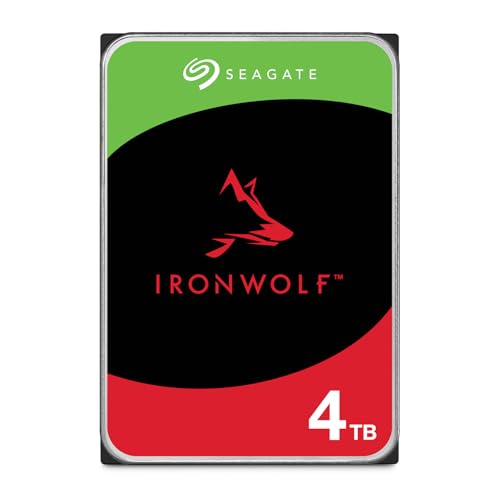
Affiliate linksCMR hard drives rated for NAS use, built to run around the clock in a multi-drive array. Check your NAS maker's compatibility list.
Seagate
Seagate IronWolf 4TB NAS Internal Hard Drive CMR 3.5 Inch SATA 6Gb/s 5400 RPM 64MB Cache for RAID Network Attached Storage Rescue Services (ST4000VNZ06/006)

Western Digital
Western Digital 4TB WD Red Plus NAS Internal Hard Drive HDD - 5400 RPM, SATA 6 Gb/s, CMR, 128 MB Cache, 3.5" - WD40EFZZ

Seagate
Seagate IronWolf Pro 24TB Enterprise NAS Internal HDD Hard Drive - CMR 3.5 Inch SATA 6Gb/s 7200 RPM 512MB Cache for RAID Network Attached Storage, Rescue Services (ST24000NT002)

Western Digital
Western Digital 10TB WD Red Plus NAS Internal Hard Drive HDD - 7200 RPM, SATA 6 GB/s, CMR, 512 MB Cache, 3.5" - WD100EFGX
Prices retrieved from Amazon on 2026-09-29 and may since have changed; the price on Amazon at the time of purchase is the one that applies. As an Amazon Associate we earn from qualifying purchases, at no extra cost to you. No manufacturer pays for a place in this list.
External backup drives
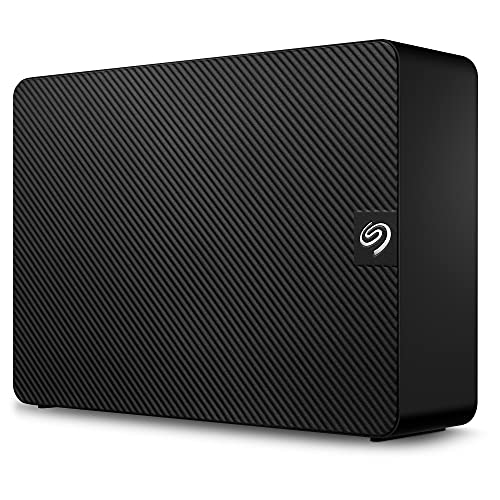
Affiliate linksDesktop external drives for the local backup copy in a 3-2-1 plan. Rotate two so one is always disconnected.

Western Digital
Western Digital 8TB Elements Desktop External Hard Drive, USB 3.0 external hard drive for plug-and-play storage - Western DigitalBWLG0080HBK-NESN, Black

Western Digital
WD 16TB Elements Desktop External Hard Drive, USB 3.0 for plug-and-play storage - WDBWLG0160HBK-NESN

Western Digital
WD 2TB Elements Portable External Hard Drive for Windows, USB 3.2 Gen 1/USB 3.0 for PC & Mac, Plug and Play Ready - WDBU6Y0020BBK-WESN
Seagate
Seagate Expansion Desktop, 4TB, External Hard Drive, USB 3.0 (STKP4000400)
Prices retrieved from Amazon on 2026-09-29 and may since have changed; the price on Amazon at the time of purchase is the one that applies. As an Amazon Associate we earn from qualifying purchases, at no extra cost to you. No manufacturer pays for a place in this list.