Types
| Type | How it works | Fits |
|---|---|---|
| Gas storage (atmospheric) | Tank, flue vented through the roof | Simple replacement for existing gas units |
| Gas storage (condensing) | Tank, recovers heat from exhaust | High efficiency, vents through a wall in plastic pipe |
| Tankless (on-demand) | Heats water as it flows, often in banks | Tight rooms, variable demand |
| Electric storage | Tank with resistance elements | Small loads or sites without gas |
| Heat pump | Moves heat from air into the tank | Low running cost, needs room air and space |
| Boiler with indirect tank | Boiler heats a separate storage tank | Large buildings, combined heating plants |
Storage or tankless
A storage heater keeps a tank of hot water ready and covers short bursts of heavy demand from the tank. A tankless heater has no reserve; its output is limited by its firing rate, so commercial installs usually link several units in a rack. Tankless saves the standby losses of a tank and space on the floor, but needs a large gas supply, and water treatment matters more because scale builds in the small heat exchangers. Many buildings end up with a hybrid: tankless units feeding a small storage tank to cover sudden draws.
Sizing: first-hour rating and peak demand
Two figures describe what a heater can supply:
- First-hour rating for storage heaters: gallons of hot water the heater can deliver in an hour starting with a full tank. Combines tank size and recovery.
- Recovery rate or flow rate: gallons per hour (storage) or per minute (tankless) the heater can raise by a stated temperature rise. Check the rise, since cold incoming water in winter lowers output.
Demand is estimated from the fixtures and equipment that run at the peak: sinks, showers, dish machines, laundry, prep sinks. Engineers and plumbing designers use fixture-count and usage methods to size commercial systems. For anything larger than a like-for-like replacement, have a plumber or engineer size it rather than guessing from the old tank.
Efficiency: condensing units
A conventional gas heater sends hot exhaust up the flue. A condensing heater cools the exhaust enough that water vapor condenses and gives up its heat, reaching much higher thermal efficiency. The trade-offs are cost and installation: condensing units produce acidic condensate that needs a drain and often a neutralizer, and they vent through sealed plastic pipe, frequently through a sidewall. They make most sense where hot water use is high.
ENERGY STAR certifies commercial water heaters, and certified units often qualify for rebates from gas or electric utilities. Check with your local utility before buying. Compare certified models in our water heater register.
Venting and the room
- Atmospheric vent into a masonry chimney or metal flue. Replacing one with a condensing unit can leave other appliances on an oversized chimney; the installer must check.
- Power vent and direct vent use a fan and sealed piping, with more location freedom.
- Combustion air. Gas heaters need enough air for combustion; tight mechanical rooms may need ducted air.
- Clearances, relief valve piping and a drain pan as the code and manual require.
Commercial water heater installation generally needs a permit and a licensed plumber or gas fitter.
Scalding and Legionella
Water temperature is a balance between two risks. Legionella bacteria can grow in lukewarm water that sits in tanks and pipes, so storage temperatures that are too low raise that risk. Water hot enough to control bacteria can scald, especially children, older people and anyone with limited mobility.
The usual engineering answer is to store water hotter and deliver it cooler: keep the tank hot, circulate it, and fit thermostatic mixing valves that blend it down before it reaches sinks and showers. Plumbing codes set limits on delivered temperature at some fixtures. Large or high-risk buildings, such as healthcare and hotels, may need a written water management program. Set temperatures with your plumber or engineer, following local code and public health guidance for your building type.
The costs people miss
- Venting changes when switching to condensing or tankless.
- Gas line upgrades for high-input tankless banks.
- Condensate drains and neutralizers.
- Water treatment to limit scale.
- Mixing valves and recirculation pumps.
- Permits, inspection and removal of the old unit.
- Annual flushing and anode checks on tanks.
Before you buy
- List the fixtures and equipment running at the peak hour.
- Have the system sized by first-hour rating or flow at your winter temperature rise.
- Choose storage, tankless or hybrid based on demand shape and space.
- Check venting, gas supply, drains and combustion air.
- Plan storage and delivery temperatures with mixing valves.
- Budget water treatment and annual maintenance.
- Ask your utility about ENERGY STAR rebates.
Thermostatic mixing valves
Affiliate linksMixing valves let water be stored hot and delivered cooler at fixtures. A licensed plumber should size and fit them.
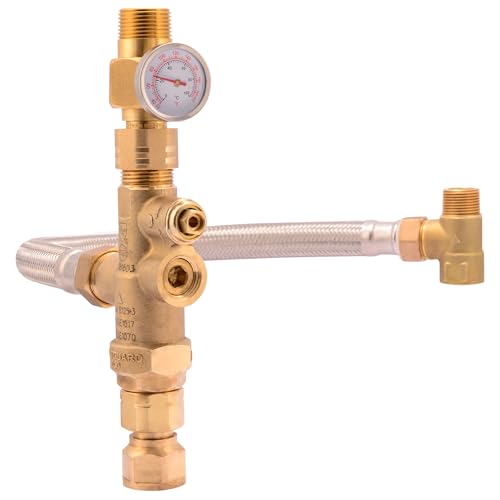
Cash Acme
Cash Acme 3/4 Inch Tank Booster Water Heater with Thermostatic Mixing Valve, Temperature Gauge, Braided Hose, Domestic and Commercial Application, PEX Pipe, PE-RT, CPVC, Copper, 24644

hps
Water Heater Thermostatic Mixing Valve with Temperature Gauge and Flexible Connector (Braided)

Honeywell
Honeywell, Inc. AM101RUS1 3/4 inch Union Sweat Proportional Thermostatic Mixing and Diverting Valve

AZK Global
AZK Global 3/4" FNPT Type Thermostatic Mixing Valve, Cert: ASSE, UPC, NSF
Prices retrieved from Amazon on 2026-09-29 and may since have changed; the price on Amazon at the time of purchase is the one that applies. As an Amazon Associate we earn from qualifying purchases, at no extra cost to you. No manufacturer pays for a place in this list.